

New Spinal Cord Interface: Restores Bladder Control and Sensation
Approximately 308,000 people in the United States are living with spinal cord injury, and for many, loss of bladder control becomes one of the most challenging daily realities. Despite this, much of neurotechnology research has historically focused on restoring movement rather than addressing essential bodily functions like bladder control.
Charles Liu, professor of neurological surgery and neurology at the Keck School of Medicine of USC and director of the USC Neurorestoration Center, emphasizes how critical this issue is. His team’s study, Intraspinal Microstimulation of Dorsolateral Funiculus for Coordinated Bladder Control, published in IEEE Transactions on Neural Systems and Rehabilitation Engineering, highlights a major shift in focus—restoring bladder function through advanced spinal cord technology. Co-authors include Vasileios Christopoulos and Shan Zhong.
For patients, the burden goes far beyond inconvenience. As Dr. Liu explains, loss of bladder control creates serious social challenges and medical risks, including repeated infections and life-threatening complications like urosepsis. Many individuals must rely on strict schedules and catheterization, which limits independence and quality of life.
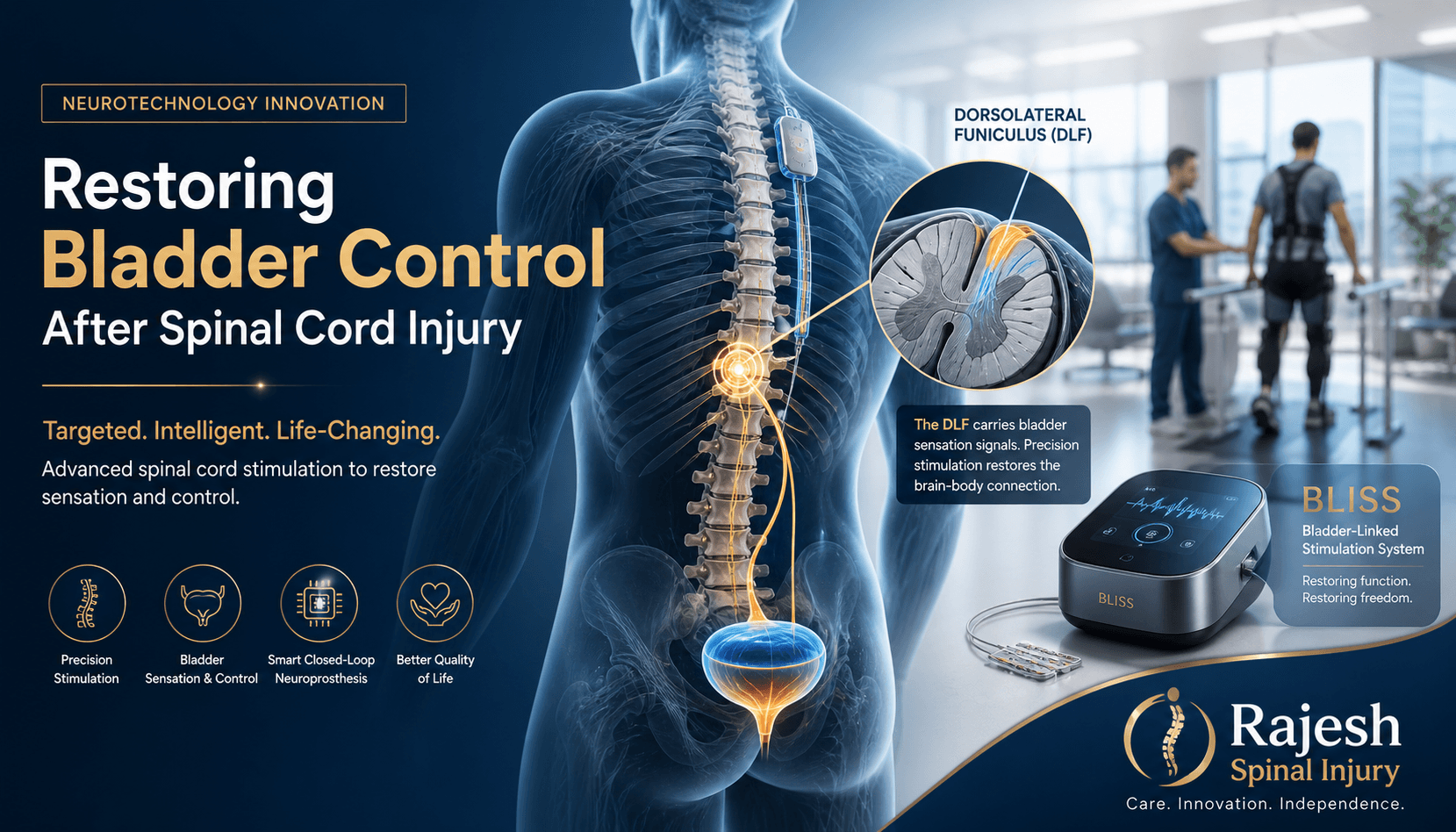
The research team is pioneering a spinal cord machine interface—distinct from traditional brain-computer interfaces. Instead of targeting the brain, they focus on the spinal cord, where specific neural pathways carry precise signals. One such pathway, the dorsolateral funiculus (DLF), plays a key role in transmitting bladder sensation signals to the brain. After injury, this communication loop is disrupted, removing both control and the natural urge to void.
Using advanced microelectrode arrays, researchers identified a tiny, highly specific region within the DLF that activates as the bladder fills. By replicating these signals through targeted electrical stimulation, they successfully triggered coordinated bladder emptying in animal models—achieving over 90% effectiveness, and even 100% under optimized conditions. Importantly, the response remained bladder-specific, without affecting surrounding muscle activity.
This breakthrough forms the foundation of a future system called BLISS (Bladder-Linked Stimulation System), a closed-loop neuroprosthetic designed to restore both the sensation of bladder fullness and the ability to void naturally. The team is now progressing toward human trials, with early-stage testing potentially integrated into existing spinal surgeries to minimize additional risk.
At Rajesh Spinal Injury, we believe awareness, innovation, and patient-centered care are essential in improving life after spinal cord injury. Advances like these offer hope for restoring dignity, independence, and a better quality of life for individuals living with spinal challenges.
View PDF File