
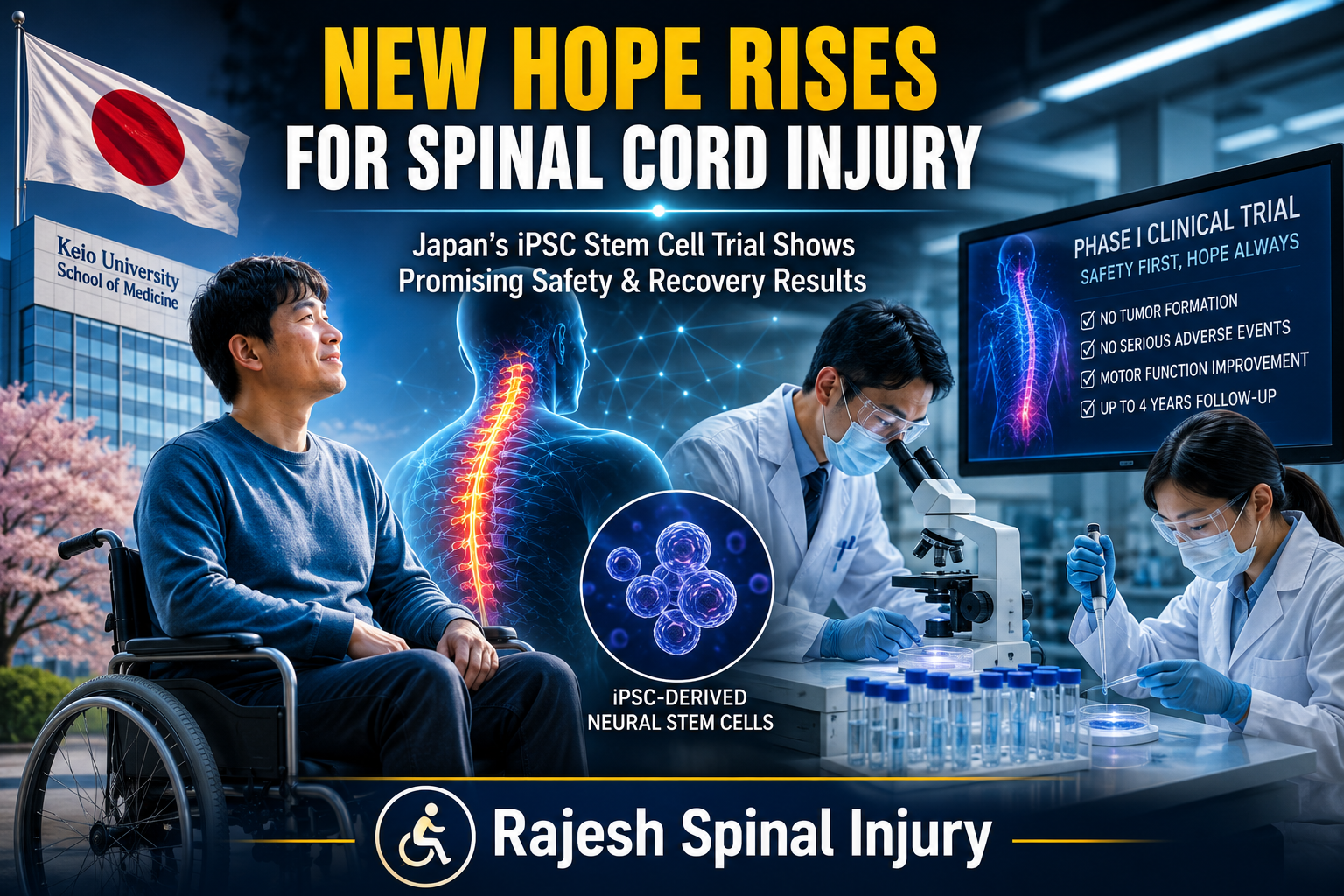
A groundbreaking clinical trial from Keio University School of Medicine and the Keio University Regenerative Medicine Research Center in Japan has reported encouraging results for people living with spinal cord injury (SCI). Published in Nature Medicine, this first-in-human Phase I clinical trial investigated whether induced pluripotent stem cell (iPSC)-derived neural stem/progenitor cells can be safely transplanted into patients with recent cervical spinal cord injuries.
Although the study was primarily designed to evaluate safety rather than effectiveness, the findings represent an important milestone in regenerative medicine and provide optimism for future spinal cord injury treatment.
Why Spinal Cord Injury Needs Better Treatments
Spinal cord injury affects more than 20 million people worldwide and is one of the leading causes of permanent paralysis. Damage to the spinal cord interrupts communication between the brain and the body, often resulting in the loss of movement, sensation, and independence.
Current treatment options include:
- Emergency spinal stabilization surgery
- Intensive rehabilitation
- Physiotherapy
- Occupational therapy
- Assistive devices
While these treatments help patients maximize their remaining abilities, they cannot regenerate damaged spinal cord tissue or fully restore lost neurological function.
What Was the Goal of the Study?
Researchers wanted to determine whether transplanting clinical-grade iPSC-derived neural stem/progenitor cells into the injured spinal cord is safe for humans.
The study included four adult men who had suffered recent complete cervical spinal cord injuries (AIS Grade A).
Each participant underwent stem cell transplantation 2–4 weeks after injury, making this one of the world’s first clinical attempts to repair spinal cord damage using laboratory-grown neural stem cells.
How the Stem Cell Treatment Was Performed
Scientists first produced high-quality induced pluripotent stem cells (iPSCs) under strict manufacturing standards.
These cells were then converted into neural stem/progenitor cells, which have the potential to develop into various nerve-supporting cells.
Approximately 2 million neural stem cells were carefully injected directly into the injured spinal cord of each participant.
To minimize immune rejection, patients also received temporary immunosuppressive therapy after transplantation.
Excellent Safety Results
The primary objective of the Phase I study was to evaluate safety.
The results were encouraging.
During both the initial 52-week follow-up and continued monitoring for up to four years, researchers reported:
- No tumor formation
- No abnormal cell growth
- No graft-related serious adverse events
- No major complications caused by transplanted cells
- MRI scans showed no transplant-related abnormalities
These findings address one of the biggest concerns surrounding pluripotent stem cell therapies—whether transplanted cells might grow uncontrollably or form tumors.
Improvements in Motor Function
Although safety was the main focus, researchers also evaluated neurological recovery.
All four participants experienced improvements in motor function.
The most encouraging findings included:
- Median motor score improved by 13 points after one year.
- Two participants improved from AIS Grade A (complete injury) to:
- AIS Grade C
- AIS Grade D
- These improvements indicate the recovery of some voluntary movement below the level of injury.
However, the researchers stressed that because the study involved only four patients and did not include a placebo group, it cannot definitively prove that stem cell transplantation caused these improvements.
Why Neural Stem Cells Are Promising
Years of laboratory and animal research suggest that transplanted neural stem cells may help repair damaged spinal cord tissue through several biological mechanisms.
Potential benefits include:
- Replacing damaged nerve-supporting cells
- Promoting remyelination of injured nerve fibers
- Supporting nerve regeneration
- Releasing growth factors that encourage tissue repair
- Helping restore communication within spinal cord circuits
Animal studies have demonstrated encouraging evidence that transplanted neurons can integrate with existing spinal cord networks, although this has not yet been directly confirmed in humans.
Limitations of the Study
While the findings are highly encouraging, researchers emphasized that this remains an early-stage clinical trial.
Important limitations include:
- Only four participants
- No placebo-controlled comparison
- All participants were men
- Only recent cervical spinal cord injuries were studied
Larger randomized clinical trials will be necessary to determine:
- How effective the therapy truly is
- Which patients benefit the most
- Whether improvements are reproducible
- Long-term safety over many years
What This Means for the Future
This study marks an important milestone in spinal cord injury stem cell therapy.
Rather than proving a cure for paralysis, it demonstrates that iPSC-derived neural stem cells can be transplanted safely into the human spinal cord under carefully controlled conditions.
Establishing safety is a critical first step before larger clinical trials can evaluate whether this regenerative approach can consistently improve neurological recovery and restore meaningful function in people living with spinal cord injuries.
If future studies confirm these early findings, stem cell therapy may become an important component of comprehensive spinal cord injury treatment alongside rehabilitation, advanced neurotechnology, and regenerative medicine.
Conclusion
Japan’s first human clinical trial using iPSC-derived neural stem cells represents a significant advance in spinal cord injury research. The successful safety outcomes and encouraging improvements in motor function provide hope for future regenerative therapies. While more research is needed before this treatment becomes widely available, the study lays a strong scientific foundation for the next generation of clinical trials aimed at improving recovery after spinal cord injury.