

AIS Scale for Spinal Cord Injury
The AIS scale spinal cord injury (SCI) is one of the most important tools doctors use to figure out how bad a spinal cord injury is. It helps figure out how much sensory and motor function a person has lost after an injury. Patients, carers, and healthcare professionals all need to understand this scale because it makes it clear how bad the damage is and what might happen during recovery.
The American Spinal Injury Association (ASIA) Impairment Scale is what the AIS stands for. The ais scale spinal cord injury system puts injuries into five groups, from no function at all to a normal condition. These levels are known as AIS-A to AIS-E and are used all over the world in rehabilitation and clinical settings.
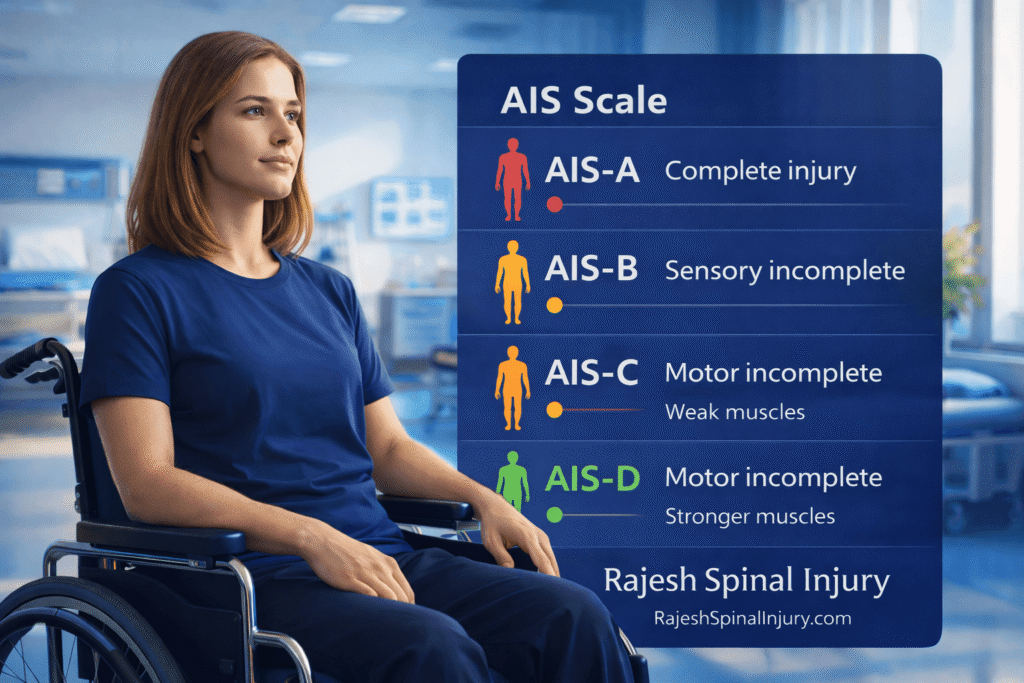
AIS Levels Explained
1. AIS-A (Complete Injury)
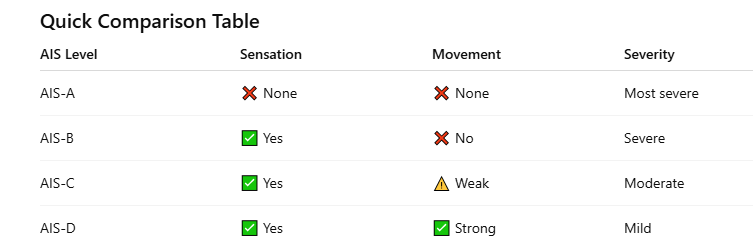
AIS-A is the most severe level in the ais scale spinal cord injury classification. In this stage, there is no motor or sensory function below the level of injury. This means the person cannot feel or move any part of the body below the affected area. Recovery chances are limited, but proper rehabilitation can still improve quality of life.
- Meaning: No movement and no sensation below the level of injury
- Control: No voluntary control (including bowel/bladder)
- Example: A person with a C6 injury cannot feel or move anything below that level
- Recovery chances: Lowest compared to other levels
2. AIS-B (Sensory Incomplete)
In AIS-B, sensory function is preserved, but motor function is absent. A person can feel touch, pain, or pressure below the level of injury but cannot move muscles voluntarily. The AIS Scale spinal cord injury classification considers this an incomplete injury, and the recovery potential is greater than in AIS-A.
- Meaning: Sensation is present, but no motor (movement) function
- Control: Can feel touch, pressure, or pain below the injury
- Mobility: No voluntary muscle movement
- Chances of Recovery: Better than AIS-A
3. AIS-C (Motor Incomplete – Weak Muscles)
AIS-C indicates that some motor function is preserved below the level of injury. However, most muscles are weak and cannot support functional movement. According to the AIS scale for spinal cord injury, muscle strength is usually below grade 3. Rehabilitation and therapy can help improve strength and independence over time.
- Meaning: Some movement is present below the injury
- Muscle Strength: Most muscles are weak (grade < 3)
- Function: May require assistance to stand/walk
- Chances of Recovery: Moderate
4. AIS-D (Motor Incomplete – Stronger Muscles)
AIS-D is a more advanced stage where motor function is strong. Most muscles have strength of grade 3 or higher, which allows for better movement and, in some cases, walking with assistance. The AIS scale spinal cord injury system indicates that individuals in this category are more likely to regain independence.
- Meaning: Movement is present and stronger
- Muscle strength: Most muscles are grade ≥ 3
- Function: Many people can walk with or without support
- Recovery chances: High compared to others
5. AIS-E (Normal Function)
AIS-E refers to normal motor and sensory function. This means that the person has fully recovered or was initially assessed without significant impairment. Although not always discussed, it is still part of the AIS scale spinal cord injury classification.\
Simple Way to Remember
- A = Absent (nothing works)
- B = Barely (only feeling)
- C = Can move (but weak)
- D = Doing better (strong movement)
Why the AIS Scale is Important
The AISA scale is important for spinal cord injury for several reasons. First, it helps doctors accurately diagnose the extent of the injury. Second, it guides treatment planning and rehabilitation strategies. Third, it allows healthcare providers to predict recovery outcomes and set realistic goals.
For patients and families, understanding the AIS scale of spinal cord injury can reduce confusion and provide a clear picture of what to expect. It also helps track progress during recovery and rehabilitation.
Recovery and Rehabilitation
The AIS scale of SCI recovery depends on the level and severity of the injury. While patients with AIS-A may have limited recovery, those in the AIS-B, AIS-C, and AIS-D categories often show improvement with proper care. Early intervention, physiotherapy, and consistent rehabilitation play a key role in maximizing recovery.
Technological advances, including assistive devices and modern rehabilitation techniques, are improving outcomes for individuals with spinal cord injuries. The AISA Spinal Cord Injury Scale remains an important reference point throughout this journey.