








• About Us
  • Contact Us
  • Spinal Cord Injury Videos
  • Disclaimer
  • Privacy Policy
Friday, January 23, 2026
Rajesh Spinal Injury
  • Home
  • Spinal Cord Injury
    • Quadriplegia
    • Paraplegia
    •  SCI Levels & Functions
    • Latest Breakthrough in SCI
    • Spinal Cord Injury Research
    • Spinal Cord Injury Videos
  • Rehabilitation
    • Physiotherapy and Occupational Therapy
    • Brain & Spine Chip Implants
    •  Epidural Stimulation
    • Stem Cell Therapy
    •  Spinal Cord Injury Drugs
  • Latest SCI News
    Spinal cord injuries in Gaza risk permanent disability for children

    Spinal cord injuries in Gaza risk permanent disability for children

    EEG technology could be a useful tool for linking brain signals with limb movements

    EEG technology could be a useful tool for linking brain signals with limb movements

    The first stage of testing of a drug aimed at complete spinal cord injury is approved in Brazil – 05/01/2026 – Science and Health

    The first stage of testing of a drug aimed at complete spinal cord injury is approved in Brazil – 05/01/2026 – Science and Health

    Injectable nanomaterials reduce secondary brain damage after ischemic stroke

    Injectable nanomaterials reduce secondary brain damage after ischemic stroke

    3 reflections from Dennis Prager after spinal cord injury

    3 reflections from Dennis Prager after spinal cord injury

    recovery is more difficult for older people with spinal cord injury | Housing

    recovery is more difficult for older people with spinal cord injury | Housing

    Study reveals how the nervous system activates repair after spinal cord injury

    Study reveals how the nervous system activates repair after spinal cord injury

    How does age affect recovery from spinal cord injury?

    How does age affect recovery from spinal cord injury?

    Older age influences functional recovery after spinal cord injury

    Older age influences functional recovery after spinal cord injury

  • Spine
    • Spinal Cord Injury Ai
  • Health News
    The growth of Inside Life Medical from a single service to a broader medical ecosystem

    The growth of Inside Life Medical from a single service to a broader medical ecosystem

    The United States officially leaves the World Health Organization

    The United States officially leaves the World Health Organization

    How an Underactive Thyroid Destroys Your Energy and Metabolism

    How an Underactive Thyroid Destroys Your Energy and Metabolism

    New owners of Crozer-Chester Medical Center plan to restore essential healthcare services to Delaware County

    New owners of Crozer-Chester Medical Center plan to restore essential healthcare services to Delaware County

    ‘The public sector must play a dominant role in healthcare’ | India News

    ‘The public sector must play a dominant role in healthcare’ | India News

    Common Triggers, Symptom Patterns, and Relief Strategies

    Common Triggers, Symptom Patterns, and Relief Strategies

    American Indians hold free MLK Day health camp in Boston

    American Indians hold free MLK Day health camp in Boston

    7 Subtle Signs Caregivers Miss (And How to Prevent Them)

    7 Subtle Signs Caregivers Miss (And How to Prevent Them)

    Beyond prevention: Routine vaccines offer surprising health benefits for older adults

    Beyond prevention: Routine vaccines offer surprising health benefits for older adults

  • Weight Loss Ai
  • More
    • NeuroScience
    • Brain Computer Interface
    • Diet-Nutrition
    • Spinal Cord Injury Videos
No Result
View All Result
  • Home
  • Spinal Cord Injury
    • Quadriplegia
    • Paraplegia
    •  SCI Levels & Functions
    • Latest Breakthrough in SCI
    • Spinal Cord Injury Research
    • Spinal Cord Injury Videos
  • Rehabilitation
    • Physiotherapy and Occupational Therapy
    • Brain & Spine Chip Implants
    •  Epidural Stimulation
    • Stem Cell Therapy
    •  Spinal Cord Injury Drugs
  • Latest SCI News
    Spinal cord injuries in Gaza risk permanent disability for children

    Spinal cord injuries in Gaza risk permanent disability for children

    EEG technology could be a useful tool for linking brain signals with limb movements

    EEG technology could be a useful tool for linking brain signals with limb movements

    The first stage of testing of a drug aimed at complete spinal cord injury is approved in Brazil – 05/01/2026 – Science and Health

    The first stage of testing of a drug aimed at complete spinal cord injury is approved in Brazil – 05/01/2026 – Science and Health

    Injectable nanomaterials reduce secondary brain damage after ischemic stroke

    Injectable nanomaterials reduce secondary brain damage after ischemic stroke

    3 reflections from Dennis Prager after spinal cord injury

    3 reflections from Dennis Prager after spinal cord injury

    recovery is more difficult for older people with spinal cord injury | Housing

    recovery is more difficult for older people with spinal cord injury | Housing

    Study reveals how the nervous system activates repair after spinal cord injury

    Study reveals how the nervous system activates repair after spinal cord injury

    How does age affect recovery from spinal cord injury?

    How does age affect recovery from spinal cord injury?

    Older age influences functional recovery after spinal cord injury

    Older age influences functional recovery after spinal cord injury

  • Spine
    • Spinal Cord Injury Ai
  • Health News
    The growth of Inside Life Medical from a single service to a broader medical ecosystem

    The growth of Inside Life Medical from a single service to a broader medical ecosystem

    The United States officially leaves the World Health Organization

    The United States officially leaves the World Health Organization

    How an Underactive Thyroid Destroys Your Energy and Metabolism

    How an Underactive Thyroid Destroys Your Energy and Metabolism

    New owners of Crozer-Chester Medical Center plan to restore essential healthcare services to Delaware County

    New owners of Crozer-Chester Medical Center plan to restore essential healthcare services to Delaware County

    ‘The public sector must play a dominant role in healthcare’ | India News

    ‘The public sector must play a dominant role in healthcare’ | India News

    Common Triggers, Symptom Patterns, and Relief Strategies

    Common Triggers, Symptom Patterns, and Relief Strategies

    American Indians hold free MLK Day health camp in Boston

    American Indians hold free MLK Day health camp in Boston

    7 Subtle Signs Caregivers Miss (And How to Prevent Them)

    7 Subtle Signs Caregivers Miss (And How to Prevent Them)

    Beyond prevention: Routine vaccines offer surprising health benefits for older adults

    Beyond prevention: Routine vaccines offer surprising health benefits for older adults

  • Weight Loss Ai
  • More
    • NeuroScience
    • Brain Computer Interface
    • Diet-Nutrition
    • Spinal Cord Injury Videos
No Result
View All Result
Spinal Cord Injury
No Result
View All Result
Home Brain Computer Interface

The Brain-Ai system translates the thoughts in motion

Editor's by Editor's
September 2, 2025
in Brain Computer Interface
0
0
The Brain-Ai system translates the thoughts in motion

Summary: Researchers have created an improved non -invasive cerebral computer interface with artificial intelligence, allowing users to control a robotic arm or cursor with greater precision and speed. The system translates the brain signals of EEG recordings into movement commands, while an AI camera interprets the user’s intention in real time.

In the tests, the participants, including a paralyzed individual, completed the significantly faster tasks with the assistance of AI, even achieving actions otherwise impossible without it. Researchers say this progress could pave the way for safer and accessible assistance technologies for people with motor paralysis or disabilities.

Key facts:

Non -invasive advance: Combine the decoding of the EEG -based brain signal with a vision of AI for shared autonomy. FASTER TASK FINALIZATION: Paralyzed participants could complete tasks that were impossible without an assistance. Accessible alternative: It offers safer lower risk solutions compared to invasive surgical implants.

Source: UCLA

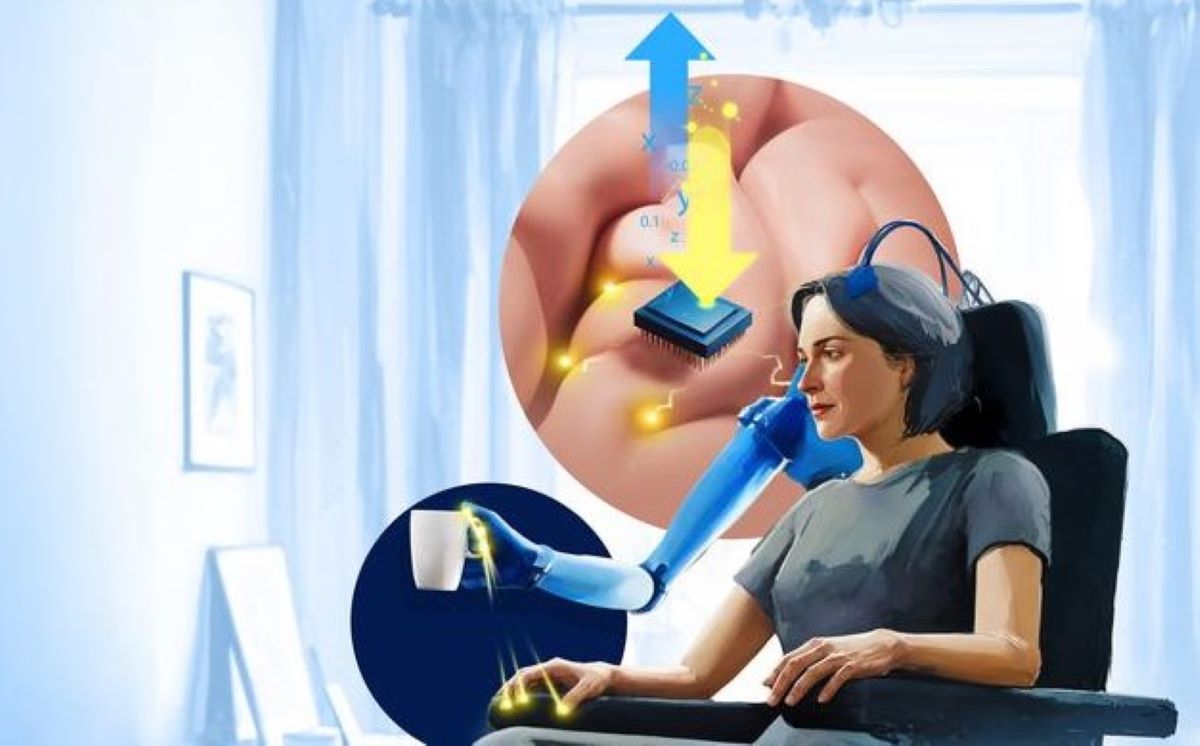
UCLA engineers have developed a portable and non -invasive cerebral computer interface system that uses artificial intelligence such as co -pilot to help inferring the user’s intention and completing tasks by moving a robotic arm or a computer cursor.

Published in Nature Machine Intelligence, the study shows that the interface demonstrates a new level of performance in the non -invasive brain interface, or BCI, systems.
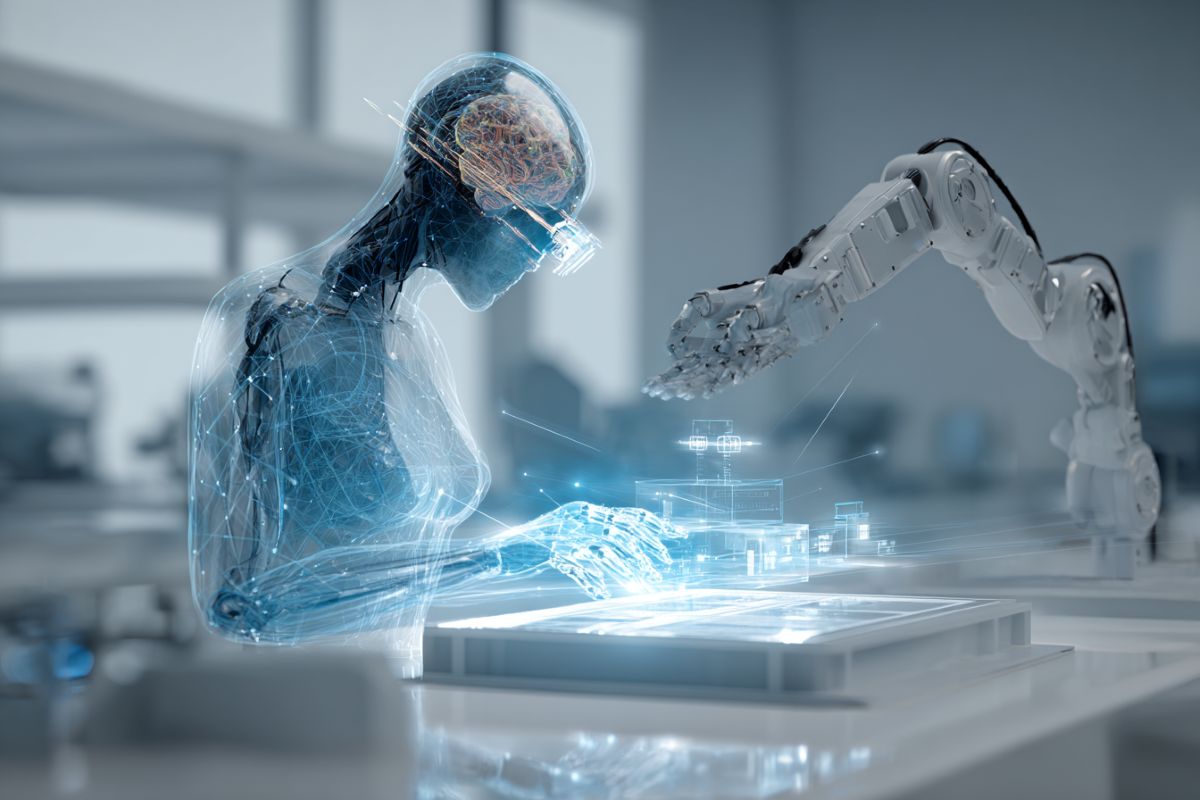
The Brain-Ai system translates the thoughts in motion
In particular, the paralyzed participant completed the task of the robotic arm in about six and a half minutes with AI assistance, while without it, he could not complete the task. Credit: Neuroscience News

This could lead to a variety of technologies to help people with limited physical abilities, such as those with paralysis or neurological conditions, managing and moving objects more easily and more precisely.

The team developed custom algorithms to decode electroencephalography, or EEG, a method to record the electrical activity of the brain, and extract signals that reflect the intentions of movement.

They matched the decoded signals with an artificial intelligence platform based on camera that interprets the user’s address and intention. The system allows people to complete tasks significantly faster than without AI assistance.

“By using artificial intelligence to complement brain computer interface systems, we are pointing to much less risky and invasive roads,” said study leader Jonathan Kao, an associate professor of electrical and computer engineering at the UCLA Samueli School of Engineering.

“Ultimately, we want to develop AI-BCI systems that offer shared autonomy, allowing people with movement disorders, such as paralysis or ELA, recovering some independence for everyday tasks.”

The last generation BCI devices and surgically implanted can translate brain signals into commands, but the benefits they are currently offering are exceeded by the risks and costs associated with neurosurgery to implement them.

More than two decades after they first demonstrated, such devices are still limited to small pilot clinical trials. Meanwhile, external BCIs and other BCI have demonstrated a lower level of yield in the detection of brain signals reliably.

To address these limitations, the researchers tested their new BCI assisted by AI-AI non-invasive with four participants, three without motor impediments and a room that was paralyzed from the waist down.

The participants carried a head limit to register the EEG, and the researchers used algorithms of personalized decoders to translate these brain signals into movements of a computer cursor and a robotic arm. Simultaneously, an AI system with a built -in camera observed the decoded movements and helped the participants complete two tasks.

In the first task, they were told to move a cursor on the screen of a computer to achieve eight goals, keeping the cursor in their place for at least half a second. In the second challenge, participants were asked to activate a robotic arm to move four blocks at a table from their original points to designated positions.

All participants completed both tasks significantly faster with the assistance of AI. In particular, the paralyzed participant completed the task of the robotic arm in about six and a half minutes with AI assistance, while without it, he could not complete the task.

The BCI deciphered electric brain signals that encoded the planned actions of the participants. Using a computer vision system, the personalized AI inferred the intention of the users, not their eye movements, to guide the cursor and place the blocks.

“The next steps for AI-BCI systems could include the development of more advanced co-pilots that move robotic arms with more speed and precision, and offer a skillful touch that adapts to the object that the user wants to understand,” said the co-leader Johannes Lee, a doctoral candidate of Electrical and Informatics Engineering from UCLA advised by Kao.

“And adding training on larger scale could also help AI collaborate in more complex tasks, as well as improve EEG decoding.”

The authors of the document are all members of the Kao engineering and neuronal computer laboratory, including Sangjoon Lee, Abhishek Mishra, Xu Yan, Brandon McMahan, Brent Gaisford, Charles Kobashigawa, Mike Qu and Chang Xie. Member of the UCLA Brain Research Institute, KAO also has appointments of Faculty in the Department of Computer Science and the Ph.D. Interdepartmental Neuroscience program.

Financing: Research was funded by the National Health Institutes and Sciences of Sciences for Humanity and Artificial Intelligence, which is a collaboration between UCLA and Amazon. The UCLA Technology Development Group has requested a patent related to AI-BCI technology.

About this research news from Neurotech and Ia

Author: Christine Wei-Li Lee
Source: UCLA
Contact: Christine Wei-Li Lee-Ucl
Image: The image is accredited to Neuroscience News

Original research: closed access.
“Cerebral interface control -Jonathan Kao, et al. Nature machine intelligence

Abstract

Cerebral computer interface control with artificial intelligence co -pilots

Motor engine computers (BCIS) interfaces decode neuronal signals to help people with paralysis to move and communicate.

Even with important advances in the last two decades, BCI face a key obstacle to clinical viability: BCI’s performance should strongly overcome costs and risks.

To significantly increase BCI performance, we use shared autonomy, where artificial intelligence co -pilots (AI) collaborate with BCI users to achieve task objectives.

We demonstrate this AI-BCI in a non-invasive BCI system of decoding electroencephalography signals.

First we contribute a hybrid adaptive decoding approach using a convolutional neuronal network and a Kalman filter similar to a readjustment, which allows healthy users and a participant with paralysis to control computer cursors and robotic arms through decoded electroencephalography signs.

Then we design two AI co-pilots to help BCI users in a cursor control task and a robotic pick-And-Place task.

We demonstrate AI-BCI that allow a participant with paralysis to achieve a performance of 3.9 times higher in the objective substance rate during cursor control and control a robotic arm to sequentially move random blocks to random locations, a task that they could not do without a co-pilot of AI.

As Ia co -drivers improve, BCIs designed with shared autonomy can achieve higher performance.

Tags: BrainAimotionSystemthoughtstranslates
ShareTweetSendShare
Editor's

Editor's

Related Posts

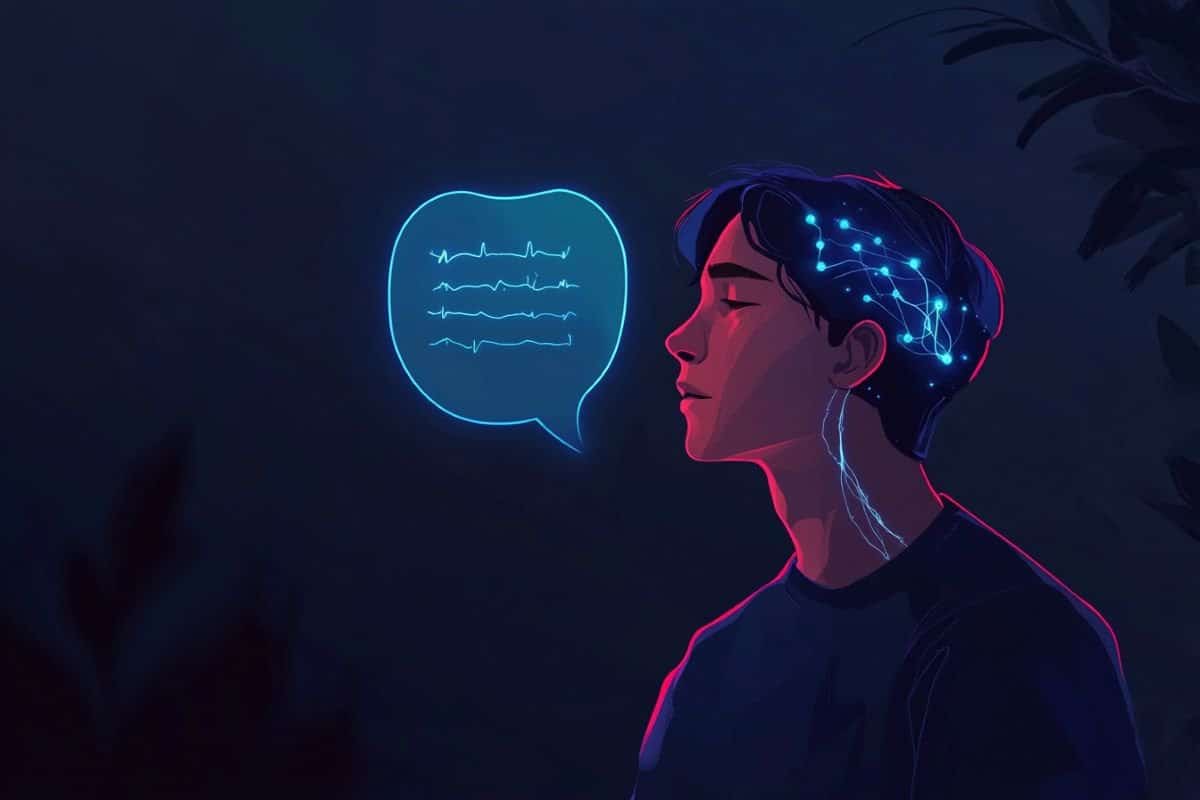
The internal discourse of “mental reading” decodes internal discourse with up to 74% precision
Brain Computer Interface

The internal discourse of “mental reading” decodes internal discourse with up to 74% precision

August 15, 2025
0
The brain AI to the voice transmits natural discourse for people with paralysis
Brain Computer Interface

The brain AI to the voice transmits natural discourse for people with paralysis

April 2, 2025
0
Advancing Prosthetics: Restoring Touch Through Brain Stimulation
Brain Computer Interface

Advancing Prosthetics: Restoring Touch Through Brain Stimulation

January 18, 2025
1
Breaking Silence: Giving the Silent a Voice Through Thoughts
Brain Computer Interface

Breaking Silence: Giving the Silent a Voice Through Thoughts

July 17, 2024
2
Robotic Arms Connected Directly to Brain of Partially Paralyzed Man Allows Him to Feed Himself
Brain Computer Interface

Robotic Arms Connected Directly to Brain of Partially Paralyzed Man Allows Him to Feed Himself

June 28, 2024
8
Brain-Machine Interface Device Predicts Internal Speech
Brain Computer Interface

Brain-Machine Interface Device Predicts Internal Speech

June 27, 2024
0
Load More
No Result
View All Result

Rajesh Logo14 White

Rajeshspinalinjury.com is the ‘Latest Spinal Cord Injury NEWS & Information’ website. 
Address:  Dhariwal, Gurdaspur, Punjab. India
Email: rajeshspinal@gmail.com

Categories

  • Brain Computer Interface
  • Diet & Nutrition
  • Epidural Stimulation
  • Health News
  • Latest SCI News
  • NeuroScience
  • SCI Research
  • Spinal Cord Injury Ai
  • Spine
  • Weight Loss Ai
No Result
View All Result

Recent News

The growth of Inside Life Medical from a single service to a broader medical ecosystem

The growth of Inside Life Medical from a single service to a broader medical ecosystem

January 23, 2026
Early intervention helps most autistic children acquire spoken language

Early intervention helps most autistic children acquire spoken language

January 23, 2026
  • Home
  • Spinal Cord Injury Videos
  • About Us
  • Contact Us
  • Disclaimer
  • Privacy Policy
  • Terms of Condition

RajeshSpinalInjury ©2025 || All Right Reserved. Design & Development by Rajesh

Welcome Back!

Login to your account below

Forgotten Password?

Retrieve your password

Please enter your username or email address to reset your password.

Log In

Add New Playlist

No Result
View All Result
  • Home
  • Spinal Cord Injury
    •  SCI Levels & Functions
    • Latest Breakthrough in SCI
    •  Spinal Cord Injury Drugs
    • Spinal Cord Injury Research
  • Paraplegia
  • Quadriplegia
  • Rehabilitation
    • Brain & Spine Chip Implants
    • Physiotherapy and Occupational Therapy
    • Stem Cell Therapy
    •  Epidural Stimulation
  • Latest SCI News
  • Spine
    • Spinal Cord Injury Ai
  • NeuroScience
  • Brain Computer Interface
  • Health News
    • Diet & Nutrition
    • Weight Loss Ai
  • Spinal Cord Injury Videos
  • About Us
  • Contact Us

RajeshSpinalInjury ©2025 || All Right Reserved. Design & Development by Rajesh