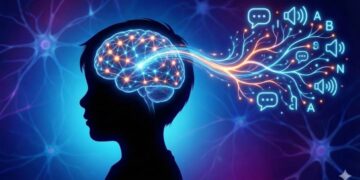



















Summary: Watching someone experience pain on the screen activates your own brain’s tactile processing system in a highly organized and body-specific way. The visual regions of the brain contain hidden maps of the body that allow sight alone to trigger sensations normally produced by physical contact.
These maps align with both where the body appears in the visual field and the part of the body being observed. The findings reveal that the brain does not simply observe the world, but actively simulates it through integrated sensory systems.
Key facts
Visual-tactile overlap: Brain regions thought to process only vision also contain organized maps of the body used for touch. Simulated sensation: Observing pain activates touch-related brain activity corresponding to the same part of the body. Clinical Potential: Findings may improve understanding of sensory simulation and social perceptual differences.
Source: University of Reading
If watching Robert De Niro order revenge with a hammer in a cheater’s hand in Casino made you cringe instinctively, you’re not alone.
Many people say that seeing bodily injuries in a movie makes them cringe, as if they “feel” it themselves. It’s like the stinger jumps directly from the screen to your skin.
But explaining why and how this happens has long baffled scientists. Now, scientists from the University of Reading, the Free University of Amsterdam and Minnesota, USA, have discovered an important clue as to why. Parts of the brain originally thought to only process vision are also organized according to a “map” of the body, allowing what we see to trigger echoes of tactile sensations.
The study, published today (Wednesday, November 26) in the journal Nature, shows that watching movies can activate tactile processing regions of your own brain in a highly organized way. In short, your brain not only observes, but simulates what it sees.
Dr Nicholas Hedger, lead author from the Center for Integrative Neuroscience and Neurodynamics at the University of Reading, said: “When you watch someone being tickled or hurt, the areas of the brain that process touch light up in patterns that match the body part involved. Your brain maps what you see to your own body, ‘simulating’ a sensation of touch even though nothing physical has happened to you.
“This cross-communication also works in the other direction. For example, when you go to the bathroom in the dark, tactile sensations help your visual system create an internal map of where things are, even with minimal visual input. This ‘filling’ reflects our different senses cooperating to generate a coherent picture of the world.”
Hidden body maps in the visual system.
To show how it is possible that our sense of touch is activated solely by visual information, the researchers developed novel methods to analyze brain activity in 174 people while they watched films such as The Social Network and Inception.
Surprisingly, brain regions traditionally considered to process purely visual information showed patterns that reflected sensations in the viewer’s own body, not just what appeared on the screen.
These visual regions contained “maps” of the body similar to those normally found in the areas of the brain that process touch. In other words, the “machinery” that the brain uses to process touch is “hardwired” into our visual system.
The study found two ways these body maps align with visual information. In the dorsal (upper) regions of the visual system, body maps match where things appear in our field of vision: the parts of the brain tuned to foot sensations were also tuned to the lower parts of the visual scene, while the parts tuned to face sensations were also tuned to the higher parts of the visual scene.
In the ventral (lower) regions, body maps match the part of the body someone is looking at, regardless of where it appears in the visual scene. Simply put, our visual system is intimately connected to our sense of touch, mapping what we observe to the coordinates of our body.
The researchers are particularly excited about the clinical applications of this research. Dr Hedger said: “This discovery could transform the way we understand diseases such as autism.
“Many theories suggest that internally simulating what we see helps us understand other people’s experiences, and these processes may work differently in autistic people.
“Traditional sensory testing is exhausting, especially for children or people with clinical conditions. We can now measure these brain mechanisms while someone simply watches a movie, opening up new possibilities for research and diagnosis.”
Key questions answered:
A: The brain visually simulates touch through integrated body maps, activating touch regions even without physical contact.
A: Yes. The visual regions of the brain are organized according to maps of body parts normally associated with tactile processing.
A: Yes. It can help explain how the brain simulates the experiences of others and why this process differs in some neurodevelopmental conditions.
Editorial notes:
This article was edited by a Neuroscience News editor. Magazine article reviewed in its entirety. Additional context added by our staff.
About this research news in sensory neuroscience
Author: Ollie Sirrell
Source: University of Reading
Contact: Ollie Sirrell – University of Reading
Image: Image is credited to Neuroscience News.
Original research: Open access.
“Indirect body maps bridge vision and touch in the human brain” by Nicholas Hedger et al. Nature
Abstract
Indirect body maps link vision and touch in the human brain
Our sensory systems work together to generate a cohesive experience of the world around us.
Seeing others being touched activates areas of the brain that represent our own sense of touch: the visual system recruits touch-related computations to simulate the bodily consequences of visual inputs.
A long-standing question is how the brain implements this interface between visual and somatosensory representations.
Here, to address this question, we developed a model to simultaneously map the tuning of somatosensory parts of the body and the tuning of the visual field throughout the brain.
Application of our model to continuous coactivations during rest resulted in detailed maps of body part tuning in the brain’s endogenous somatotopic network.
During video viewing, somatotopic tuning accounts for responses throughout the dorsolateral visual system, revealing a series of somatotopic body maps that overlay the cortical surface.
Body position tuning of these maps aligns with visual tuning, predicting both preferences for visual field locations and visual category preferences for body parts.
These results reveal a mode of brain organization in which aligned visual-somatosensory topographic maps connect visual and bodily reference frames.
This multimodal interface is ideally situated to translate raw sensory impressions into more abstract formats that are useful for action, social cognition, and semantic processing.