


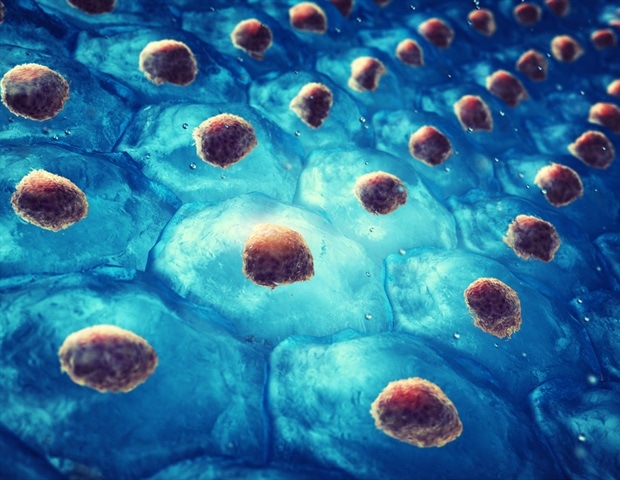











Only two weeks after fertilization, the first signs of the formation of the 3 axes of the human body (head/tail, ventral/dorsal and right/left) begin to appear. In this stage, known as gastrulation, a flat, featureless sheet of cells folds into a living blueprint for the body, a fleeting transformation into axes and layers that will determine how each tissue develops. However, this very important moment has long been beyond the reach of science, as it occurs too early and deep inside the womb to be studied directly.
Now, a new study reveals that this fundamental step in human development is guided by a precise interplay between chemical signals and physical forces. Published in Cell Stem Cell, the paper presents a light-based synthetic embryo tool that allows researchers to activate key developmental proteins known to initiate gastrulation. When the team used light to activate one of these proteins, BMP4, they discovered that chemical signals alone were not enough: transformation began only when the cells were also in the correct mechanical conditions. The results reveal a fundamental interdependence between tissue mechanics and molecular signaling, offering a more faithful model of early human development and a potential basis for future fertility and regenerative therapies.
Now we can generate self-organization and different types of cells, simply by shining light on them. “This allowed us to make an important discovery about the role of mechanical forces in embryonic development.”
Ali H. Brivanlou, head of the Synthetic Embryology Laboratory at Rockefeller University
Advancement in optogenetics sheds new light
Gastrulation begins with the breaking of symmetry. A uniform sheet of embryonic cells is organized into a three-dimensional head-to-tail axis—the spatial blueprint that determines where the head, spine, and limbs will eventually form. Brivanlou and his colleagues have been unraveling the mystery of this key stage of development for decades, with the help of animal models and laboratory studies of human embryonic stem cells. “Gastrulation occurs in the uterus shortly after implantation, so it cannot be studied without the use of human pluripotent stem cells, in vitro,” says Riccardo De Santis, director of the Rockefeller Human Pluripotent Stem Cell Resource Center and co-first author of this study, along with theoretical physicist Laurent Jutras-Dubé. “Our goal was to open a window into a time of development that could not otherwise be studied in vivo.”
Previous work demonstrated that biochemical signaling molecules, such as BMP4, influence the behavior of cells and tissues to regulate embryonic development. But studies on frog and chick embryos suggested this was only part of the story. Mechanical stress, tissue geometry, and various physical forces also appeared to play a role in the development of animal embryos. “There is finally a lot of data coming in and it is now clear that the role of mechanical signaling has been underestimated,” says De Santis.
De Santis developed an optogenetic tool that allows the team to investigate the interaction between biochemical signals and mechanical forces, within the context of human development. By engineering human embryonic stem cells to respond to light, their system allowed researchers to activate developmental genes with extraordinary precision. When exposed to a specific wavelength of light, the cells were engineered to activate a genetic switch that permanently activates BMP4. This setup also allowed the scientists to choose exactly when and where the signal is activated in the embryonic cell cluster, allowing them to test, for the first time, how tissue geometry and mechanical stress at any physical location in the embryo could influence development.
The increase in mechanical forces.
When the team used this light-based system to activate BMP4 signaling in human stem cells, the role of mechanical forces quickly became clear. In cultures where BMP4 was activated in free, low-stress environments, gastrulation never fully fused. BMP4 alone was enough to give rise to extraembryonic cell types, such as those that form the amnion, but the sample failed to generate mesoderm and endoderm, the layers that build the body’s organs. This demonstrated that morphogens alone are not sufficient to achieve gastrulation.
But when the team aimed their “remote control” at the edges of confined cell colonies and at cells embedded in tension-inducing hydrogels, the missing layers of gastrulation began to form. Additional experiments revealed how mechanical stress through YAP1 fine-tunes downstream biochemical signaling pathways mediated by WNT and Nodal, which tell cells what tissue types they should become. A previous study led by senior research associate Francesco Piccolo, in collaboration with the late Jim Hudspeth, head of the Rockefeller Sensory Neuroscience Laboratory, demonstrated that nuclear levels of the mechanosensory protein YAP1 play a crucial role in regulating self-organization into micropatterns (Piccolo et al., 2022). The present study revealed that nuclear YAP1 acts as a molecular brake on gastrulation, preventing these transformations from occurring too early. The results suggest that gastrulation can begin only when molecular signals and mechanical stress align; The cells, it seems, must be prepared chemically and physically.
“There has been so much beautiful molecular biology in the embryo, so much incredible work on signaling. But, as a field, we have neglected the physical forces,” Brivanlou says. “It is now clear that without mechanical forces we cannot generate cells for proper embryonic development.”
The results not only demonstrate the power of optogenetic tools and the importance of mechanical forces, but also provide a new framework for understanding how human embryos are organized in the early stages. To complement the experiments, Laurent Jutras-Dubé developed a mathematical model that acts as a “digital twin” of a developing embryo. This computer simulation shows how biochemical signals such as BMP4, WNT and NODAL move through tissues and interact with physical forces. By using actual measurements of mechanical strain, the model can predict how signaling patterns and tissue organization lead to specific cell layers. The simulations closely match what was observed experimentally, demonstrating that both biochemical signals and mechanical stress must work together for this embryological signaling cascade to self-organize. This integrated approach provides a quantitative way to understand how the embryo changes during early development. Built on a microchip platform, these improved synthetic embryos build on landmark work from Brivanlou’s lab, which, in 2014, was the first to demonstrate that human embryonic stem cells grown on microchips could self-organize into two-dimensional “gastruloids” that mimic early developmental patterns.
Next, the team plans to explore the possible existence of a mechanical organizer, a strength-based counterpart to the classical signaling centers that shape the early embryo. They suspect that, in addition to chemical signals, the embryo must satisfy specific physical conditions to progress through developmental milestones, a state the authors call mechanical competence. “The existence of a mechanical organizer is a provocative concept that could prove transformative,” says De Santis.
Beyond its conceptual impact, the remote-controlled optogenetic embryo offers an unparalleled platform for experimentation, enabling light-driven control of developmental signals in engineered microenvironments. These systems could advance regenerative medicine and reproductive health, from perfecting stem cell therapies that activate on demand to clarifying why early pregnancies sometimes fail. “Our work focuses on fundamental biology and basic science, but the implications are really important in terms of supporting fertility,” says De Santis. “When we improve our understanding of the underlying rules of embryogenesis, we will be able to use that information to give people the best opportunities to form future families.”
The present work already offers an unprecedented vision of where we all begin. “Sometimes scientists get lost in the tools, the chips and the lights, and we forget that this type of research is special,” Brivanlou says. “When I look at gastrulation, I feel like I’m looking at a mirror that reflects my own past. It’s more than just science. It’s an opportunity to see where we all come from: that magical stage of development that makes us who we are.”
Fountain:
Magazine reference:
De Santis, R., et al. (2025). Crosstalk between tissue mechanics and BMP4 signaling regulates symmetry breaking in human gastrula models. Cellular stem cell. doi: 10.1016/j.stem.2025.09.006. https://www.cell.com/cell-stem-cell/abstract/S1934-5909(25)00337-6